9.8.09

'Spider-Man' musical halted?
Producers insist money issues won't derail show

By GORDON COX

August 6, 2009


Should Broadway's Spidey sense be tingling?
Rumors have spread among legiters that the production sked for incoming mega-musical "Spider-Man, Turn Off the Dark" may be threatened.

The extensive work being done to prep for the technically demanding show, both in the shop constructing the physical production and in the theater where "Spider-Man" is due to bow, is said to have stopped this week.

The halt is attributed to cash flow obstacles that producers -- including David Garfinkle, Martin McCallum, Marvel Entertainment and Sony Pictures Entertainment -- are working to resolve, according to some in the industry affiliated with the show.

One explanation suggests the delay stems not from problems in raising the massive funds required for the tuner -- said to be capitalized at north of $35 million -- but from issues in mobilizing those great big chunks of coin.

A rep for the show would say only that the production remains on track to begin previews at the Hilton Theater Feb. 25, with an opening to follow some time in March.

Others attached to "Spider-Man" acknowledge the funding hiccup but believe the situation will be resolved without forcing a disruption of the musical's launch.

Nevertheless, the chatter has served as an alarming suggestion of instability in a production generally expected to become the sales juggernaut of the 2009-10 season.

Current work stoppage also comes hot on the heels of a Marvel earnings report earlier this week that saw the company post a 38% drop in profits on a 26% reduction in revenue during the second quarter, a slide prompted largely by the lack of a major movie release since "Iron Man" and "The Incredible Hulk" last year. (Still, Marvel logged a profit of $29 million on revenue of $116 million.)

Most legiters anticipate the musical, with music by Bono and the Edge of U2 and helmed by Julie Taymor ("The Lion King"), will rake in monster amounts of cash right out of the gate. Even if reviews and word of mouth prove dire, hype and curiosity are expected to drive ticket sales for a solid stretch of time.

The season's Rialto cume would surely suffer without that sales spike, thereby hindering Broadway's ability to keep pace with the record-setting grosses posted for the 2008-09 season.

For now, "Spider-Man," with a cast that so far features Evan Rachel Wood as Mary Jane Watson and Alan Cumming as the Green Goblin, remains officially set to swing into previews in February.

source: variety

8.8.09

Croatian fans to prepare balloon surprise for U2
August 8, 2009
Croatian Times


Croatian U2 fans are calling on all those who will attend the group’s concert on 10 August to use balloons to welcome the Irish band.

The idea’s initiator, U2Croatia.net website forum, said today (Fri) the idea was to make an Irish flag across the whole stadium with the balloons.

Everyone should bring one balloon to the concert. All those in the west stands should have green balloons, those in the north and south stands and on the pitch white balloons and those in the eastern stands orange balloons.

The balloons should be prepared but not tied before U2 takes the stage.

During the first song, people should hold the balloons in the air and then release them when the song ends.
croatiatimes
'Something I've Never Seen Before'
07 August 2009
Gary Lightbody of Snow Patrol was so knocked out by last night's show in Katowice that he sat down and wrote us this piece.


I had to write about this. I simply had to. I hope I'm not speaking out of turn here as this is U2's site and hallowed ground for all of you but this story needs to be told. The shows so far on this tour have all been amazing and each night the crowd's reaction to U2 has been loud and joyous and passionate. Last night in Poland though was something else. Hard to explain. Let me try.

I have never in my life seen a crowd reaction like that of Katowice last night. Right from opener Breathe there was a daft magic in the air. Insanity everywhere you looked. People's faces clothed in the kind of joy I've only seen in gospel churches and then only on the TV so to see this religious fervour up close was overwhelming. The city outside the stadium could have been under heavy fire from alien spacecraft and I don't think anyone would have heard, saw, or indeed cared that much.

Then The Edge takes to the piano for New Year's Day (playing it guitar pick still between his fingers!) and the place is bathed in red and white instantly. Red cards held aloft by the people on the floor and white cards in the seats to make a giant Polish flag you could probably see from space. It took the breath clean out of me. By the end even Bono was speechless, for a few seconds anyway. The things he said next are lost to me verbatim but what I won't forget is the tears that came to me then. In floods. And when I turned to check if anyone had snared me for blubbing I realised that every single person around me also had tears in their eyes. We were sharing something that simply never happens at rock shows anywhere. A collective emotional and spiritual surrender of epic proportions. This was majesty and tenderness married and that is a rare thing indeed.

Last night was something I've never seen before and I can't quite fathom it. Not sure I ever will or even want to. It will sit alongside the greatest nights of my life and I thank U2 and Poland for that. Also thank you to the Polish U2 fans for giving us the best reaction to our own set we've had on this tour so far. All in all then a night of triumphs.


I would tour with this band (we all, us Patrollers, would) 'til the last grain of sand tipped gently into the bottom half of the hourglass and yes that sounds (and perhaps is, why not) a massive hint hint to stay on this magic carpet ride a little/a lot longer but believe me when I say this: this is the greatest show on earth. Why on earth would you buy just anyone's cockatoo? Long may they reign!

Gary Lightbody, aged 33, Bangor, Northern Ireland, Overwhelmed.x

U2.com
This Instrument Was Calling Out To Me
06 August 2009
A documentary on the electric guitar, 'from the point of view of three rock legends', It Might Get Loud tells the personal stories of three generations of electric guitar virtuosos - The Edge, Jimmy Page and Jack White.

'It reveals how each developed his unique sound and style of playing favorite instruments, guitars both found and invented. Concentrating on the artist's musical rebellion, traveling with him to influential locations, provoking rare discussion as to how and why he writes and plays, this film lets you witness intimate moments and hear new music from each artist. The movie revolves around a day when Jimmy Page, Jack White, and The Edge first met and sat down together to share their stories, teach and play.'

We'll be bringing you more on the film in the coming days, meantime, take a look at this preview clip.


More on the film here and other upcoming North American city openings.

3.8.09

This much I know
Adam Clayton, musician, 49, Amsterdam


Luke Bainbridge The Observer, Sunday 2 August 2009 Article history


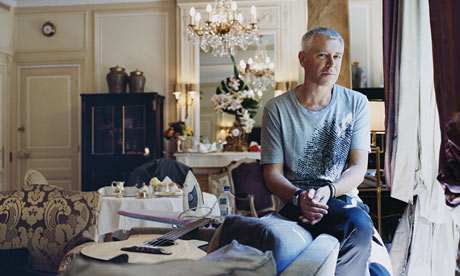
Adam Clayton in Paris. Photograph: Kevin Davies

I don't think rock'n'roll is necessarily a young man's game. I think Neil Young is just as rock'n'roll now as he was in his 20s. I'd like to think we can still be edgy and challenging.

I was not an obvious contender. I was actually pretty shy in school. My defence mechanism was to be the class clown. I remember getting into a lot of trouble for being disruptive, and I was brought in front of the headteacher, who said: "What's going to happen to you; what are you going to do when you grow up?" and I said: "Well, I'm obviously going to be a comedian."

From an early age I didn't buy into the value systems of working hard in a nine-to-five job. I thought creativity, friendship and loyalty and pushing the boundaries of what was acceptable was much more interesting.

The longevity of U2 is primarily based on the friendship of four men that have grown up together. Four men that respect and support and love each other. We won't let each other fail.

It's very confusing when fame comes early on in your career. You get a little bit bent out of shape in terms of what's important. Fame is like the dessert that comes with your achievements - it's not an achievement in itself, but sometimes it can overpower the work.

I really enjoy the privileges of fame now. It opens doors and allows you to meet people, and you're in control. When fame first happened I didn't feel in control, and it closed doors to me.

I've never necessarily chosen to be a bachelor. I've had girlfriends throughout the last 20 or 30 years. It's just that there were times when I met people that fascinated me and times I didn't.

The biggest misconception about me was that I was some kind of wild, crazy rock'n'roll firework. It was an easy image to pick up on, but I'd like to think I was a little deeper than that.

I stopped drinking 12 years ago, and it was time. I'd had enough of drinking, drugging and nightclubs. It was a difficult decision to change my life, and it took a while to reprogram, but I've no regrets at all. I've enjoyed every bit of my life. I've had the best of it both ways.

My greatest achievement is managing to cope with four fingers and four strings.

The worst thing that ever happened to me was being busted. It wasn't that I was treated particularly badly, it was just so stupid, so pathetic, to be busted for cannabis. It was a big newspaper story, and it becomes a whole talking point with your parents and your parents' friends and your friends' children, and you just don't want that debate opened up.

I feel there is a lot more to achieve. In the first 20 years I was functioning on instinct and attitude and rawness, and now I know what I'm doing and can apply those skills in a different way. It's no longer about attitude and rawness, but it's about sophistication and understanding.

If I could only take one thing on tour it would be Irish tea bags. Barry's decaffeinated tea bags. I know it sounds crazy, but if you don't travel with your own tea, it never tastes the same.

In a loving relationship, as an expression of freedom and fantasy, I think sex is very important.

I don't think I would ever try and repeat U2. I'd be very happy when U2 came to whatever end, and there is no end, really. But I would be happy to move on. It's a very fast world, and a quieter world would be welcome at some stage.

I can look at myself in the mirror. I didn't use to be able to do it. I see someone who is incredibly lucky, who still has so much ahead of him rather than behind him, and I'm very grateful. I cannot believe how good my life is. I did not expect this.

• U2 plays Wembley Stadium, London on 14 and 15 August

guardian
U2 Academic Conference Registration Opens; Q&A With Organizer, Scott Calhoun
Category: Academia • Music • The Old North State
Posted on: August 1, 2009 6:02 AM, by Abel Pharmboy


During the summer between high school and college, about this very time in 1981, I was sitting at a beach house in North Carolina listening to my uncle rail against The Beatles. He held that the band never truly took its fame and international press attention to doing anything good for the world except to glorify LSD.

I now get to tell him about U2.

That summer also saw the launch of MTV and in fall I watched four young Dubliners on a barge playing a song called, "Gloria," the opening track of their album October. And in the intervening years the band, and especially its lead singer Bono, have used their international platform to raise awareness and act upon injustices worldwide. In 2002, Bono and Bobby Shriver co-founded the humanitarian organization DATA (debt, AIDS, trade, Africa), known now as ONE. Among their many causes, the pharmacologist in me has been most impressed with ONE and Bono's personal efforts to make antiretroviral HIV/AIDS drugs available in sub-Saharan Africa.

I've long been a fan of the band, U2 - so much so that during graduate school I played in a U2 tribute band (I was Adam Clayton). So imagine my delight when I read this in a press release a few weeks ago:

ACHTUNG U2 FANS Come spend a few days talking, listening and thinking about what U2 has done. We're bringing together scholars, teachers, students, journalists, clergy, musicians and intellectually curious U2 fans for a rich program of exploring this truly one-of-a-kind band for a truly one-of-a-kind conference, and we hope you'll be in the room.
Is it all so much hype? Are we lost in their feedback? Or is this band of ambitions, paradoxes, ironies and sincerity the real thing? If you think U2 has played a role, for better or worse, in changing the worlds of music, entertainment, popular culture, humanitarian relief, peace and social justice efforts - or has changed the world in you - then come join the conversation. Meet us in the sound!


U2: The Hype and The Feedback is the first academic conference devoted to the band and will be held on the campus of North Carolina Central University (NCCU) in Durham, NC, over the weekend of October 2-4, 2009. The date coincides with the band's 3rd October concert in Raleigh and, coincidentally, the 28th anniversary of the release of October.

Registration opened today and Tracey Hackett just put up a nice article about the conference overnight.

In addition to smaller concurrent sessions, the conference will include keynote speaker, Anthony DeCurtis, longtime contributing editor at Rolling Stone, British music critic Neil McCormick, Ugandan nurse and AIDS activist Agnes Nyamayarwo, @U2 founding editor Matt McGee, and Jim Henke by video from the Rock and Rock Hall of Fame Museum.

Conference organizer, Dr. Scott Calhoun, is Associate Professor of English at Cedarville University and teaches journalism, literature, and composition courses. I was fortunate to nail down Scott in the flurry leading up to today's commencement of conference registration.


How does one convert a love of U2 into a scholarly activity? Do you actually incorporate U2 works into your course offerings?

U2 is one of those rock bands that approaches making and performing music as a craft. The band members are well-schooled in music and art history, as well as in literature, film, religion and politics. The music they make and the performances they give are works, if you will, that we in the humanities find it natural to study and discuss. The poetics and rhetorics of the texts U2 have created are rich fields of inquiry for exploring the human condition. I've incorporated their work into discussions in my classes, from a single song to a whole album. Sometimes there's an "unfamiliarity gap" that needs to be bridged, but it's never been hard to persuade an open-minded person that U2 makes music for the heart and mind - the kind of music that makes you feel something and want to start asking questions.

So, there are scholarly publications about U2?

There is a growing body of academic writing about U2. In the past 10 years or so, more books have been coming out that are more of inquiries into the band's work than fan treatments. I have a bibliography of most of the major book treatments on U2 in English at the site. http://www.u2conference.com/biblio.php

That's a great resource on the conference page. Between the speakers and the papers listed thus far, the meeting schedule looks to be quite vibrant and eclectic. How did you go about soliciting contributors of papers for the conference?

We issued a Call for Papers through the Chronicle of Higher Education and the normal listservs that cover the humanities and theology/philosophy disciplines. I write for @U2 (www.atu2.com) and Books & Culture, and we spread the word through those channels as well. Most academics who think, write and teach about U2 are well-connected in the on-line world, so it wasn't hard to get the word out. We received nearly 100 paper proposals.

I only just learned of the conference from your press release but I just read a blogpost from June by News & Observer music writer David Menconi that you had narrowed down the conference site to North Carolina Central University and Oxford, MS (presumably at Ole Miss)? How did NCCU win out?

Both schools made appealing offers, and Durham and Oxford have great U2 fan communities. Some really motivated U2 fans in Durham kept reaching out to us and helped us connect with NCCU. With NCCU's rich history of educating the community through the arts and music, as well as their special focus on honoring the oppressed and the champions of freedom for all peoples, we thought this was a great place to have the first academic conference on U2. The more you look into the missions and histories of NCCU and U2, the more you see both have had a common "goal of soul" and "elevation." ;) There's also a U2 concert close by the same weekend as the conference!

There is an interesting aspect of the spirituality and commitment to social justice and civil rights evident in the lyrics of U2. NCCU is a historically-black college/university (HBCU) currently celebrating the 100th anniversary of its founding - despite being a state university now, NCCU was originally founded as "The National Religious Training School and Chautauqua for the Colored Race." Did this convergence of the university's centennial and its original mission play any role in having NCCU host the conference?

We're thrilled to be a part of NCCU's centennial year celebration. When I learned of NCCU's original founding purpose, all I could think of was how the spirit moves in mysterious ways. ;) I hope we honor the intentions of those early Chautauquians!

The question whose answer everyone wants to know: Any chance that any U2 members will make a cameo at the conference?

If they can come and not affect our academic objectivity, they are more than welcome to stop in! We've invited them, of course, and don't know of their intentions at this time.


If readers have any other questions for Dr. Calhoun, just drop them in the comments and I'll see if he can get to them.

Thanks, Scott, for taking time to give us a little more insight about the conference.

Here is an overview of registration information from Tracey Hackett's article:


Early bird registration fees, which run from Aug. 1 through Sept. 7, are $129 for students with active identifications and $179 for the public. Standard registration fees, which run from Sept. 8 until the conference reaches capacity, are $149 for students and $209 for the public. Both early and standard conference registrations include costs for a reception on Friday and lunch on Saturday and Sunday.

One-day registrations, for either Saturday or Sunday and includes lunch for that day, is $89 for students and $129 for the public. A ticket for the Friday evening kick-off event and reception only is $25.

Conference registration does not include the cost of lodging or purchase of a ticket to U2's Raleigh concert.

The cost of registering for the conference can be paid for by check, PayPal account, or credit card via PayPal.


For more information and registration for the conference, log onto its web site at www.U2conference.com. You can also follow conference development on Twitter, Facebook, and the official conference blog.

source: scienceblogs
Ego warriors: U2 speak out on rock-star hypocrisy
Over the years, U2 have taken many a kicking. But the band believe they're unjustly maligned for their unique brand of 'stadium activism'


Dorian Lynskey guardian.co.uk, Thursday 30 July 2009 21.30 BST


Bono on U2 ... 'They get kicked because I'm in the band'. Photograph: Kevin Mazur/WireImage.com

Tuesday night in Amsterdam. Inside the city's ArenA, the colour green floods a giant mosaic of video screens, below which stand the four members of U2, three weeks into their 360 tour. As the band strike up Sunday Bloody Sunday, the screens flash images of protesters on the streets of Tehran alongside lines in Farsi by the Persian poet Rumi. Thus, a song written 26 years ago about political violence in Northern Ireland finds a new and pressing context.

The sequence vividly illustrates U2's unique brand of stadium activism. There's also a tribute to the incarcerated Burmese opposition leader Aung San Suu Kyi during Walk On, and a recorded message from Desmond Tutu for the One campaign, co-founded by Bono to mobilise support for developing country debt relief and HIV/Aids treatment, among other issues. No globally successful rock band has ever foregrounded politics for so many years, let alone stalked the corridors of power to help thrash out deals, which is why representatives from Amnesty and the World Food Programme cross paths with Helena Christensen and Anton Corbijn in the VIP area.

Equally, the sequence demonstrates the limits of U2's approach. The band have always worked on the principle that in the awareness-raising business something, however imperfect, is better than nothing, but Iran-watchers might justifiably argue that an emotive one-minute montage simplifies, even trivialises, a complicated situation. It really depends on how much imperfection you're willing to accept.

For U2's most dogged critics, the answer is: not much. Around the time of Live 8, the travel writer Paul Theroux branded Bono one of the "mythomaniacs – people who wish to convince the world of their worth". After U2 moved part of their business to the Netherlands to reduce their tax burden in 2006, the Daily Mail dubbed the singer "St Bono the Hypocrite". The Irish writer Eamonn McCann recently labelled U2's music "a toxic cloud of fluffy rhetoric, a soundtrack for the terminally self-satisfied".

The subject of such opprobrium sits in his Amsterdam hotel suite, breakfasting on black coffee and cornflakes, and ponders the downside of being the world's most famous rock star activist. "A little information can do a lot of harm," he says, his voice hoarse from the previous night. "A lot of people don't know what I do so they think, 'He's just turning up in photographs with starving Africans or some president or prime minister. We don't like that. Rock stars telling elected officials what to do, and then they run back to their villas in the south of France. Fuck 'em.'" But, he insists, "if you look into it you think, 'This guy works two-and-a-half days a week at this, not being paid for it, and at cost to his band and his family, and doesn't mind taking a kicking.'"

With his hair cropped short, and his body bunched and compact like a fist, Bono resembles a retired boxer, jabbing the air to make his points. When I meet the rest of U2 individually, their body language also speaks volumes. Guitarist the Edge is serenely quiet and still, except when his eyes crinkle slightly in concentration or mirth. Bassist Adam Clayton sprawls louchely on a sofa, with a perpetual air of mild and mysterious amusement. Drummer Larry Mullen Jr leans forward intently, punctuating his responses with an apologetic grimace as if, far from being the man who founded U2, he had simply won a competition to be the drummer in a rock band. "Nothing with U2 really makes sense," he says, eyes widening. "I have no idea how we managed to get to this place."

The history of rock stars who take on politics is somewhat chequered. Bob Dylan repudiated it, John Lennon tied himself in knots over it, and the Clash were crushed by sky-high expectations. U2's activism has somehow endured and flourished. Their political outlook was shaped by being young and Irish in the late 1970s. As a result of temperament as much as circumstance, U2 could neither play with Clash-style guerrilla chic nor take sides.

"People in the south were always revolted by the acts of terrorism and brutality in the north," says Clayton. "But to express it would have been to sympathise with the Brits, so it was complicated. We were part of finding a spiritual dimension to it rather than just standing at the barricades."

In the early 1980s, U2 were racked by sincerity, applying to such baleful issues as the Troubles, apartheid and the threat of nuclear war a spiritual perspective influenced by soul music and Bob Marley. "You can certainly hear that in the recordings," says the Edge. "Some of it's overwrought and way too intense. There was almost a desperation in the performances to make a connection, which didn't help at times. Our lives seemed to depend on it. There was a sense that it could go all the way or it could go nowhere."

Of course, it went all the way, and U2 clung to the principle of accentuating the positive: Pride (In the Name of Love) mutated from an attack on Ronald Reagan into a celebration of Martin Luther King. Nonetheless, they acquired a grimly humourless image: "These are really serious guys from war-torn Ireland and they've got a thing or two to tell you," as Clayton drily puts it. Their 1992 Zoo TV tour introduced a life-saving element of ironic distance, with its crank calls, costumes and media overload. "By that point, we'd figured out that it's sometimes enough to ask the right question," says the Edge. "You don't necessarily have to come up with an answer."

In the last decade, things have got more complicated. U2's formidable manager, Paul McGuinness, used to tell Bono that an artist's job was to describe problems, not to fix them, but since Bono was first approached to join the Jubilee 2000 debt-relief campaign, he has trod the minefield of top-flight hands-on activism. It is an almost oxymoronic role: the rock star diplomat. "Our job is to bring him back to his position as an artist," says the Edge. "Artists don't have to deal in the muddy grey of political reality. They can see things in black and white terms – ideals. There's an aspirational aspect to rock'n'roll, whereas politics is just one compromise after another."

Bono had the additional misfortune of having to twist arms in Washington during a time when the most divisive president in decades was preparing to launch the most divisive war in decades. As the Iraq fiasco deepened, Bono maintained a diplomatic silence, and images of him beside a grinning George Bush (whom Clayton dismissively refers to as "the other fella") returned to haunt him. He is grateful to the film-maker Michael Moore for kind words at the time. "He said, 'Look, this must be very difficult for you, doing what you're doing while the rest of us are mobilising against this war. I want you to know that you don't have to do everything – you just have to do something.' It was a great feeling."

But even with Bush gone, Bono relies on cross-party support for his campaigns. Two weeks ago, he revealed to Jonathan Ross that he had dodged a hug with Bush during a 2006 photo-op, and rightwing bloggers howled in outrage, causing trouble for his campaigning partners. "It's very hard for me to keep quiet about anything," he says, smiling. "I'm more used to putting my foot in my mouth than I am biting my hand." He says he was known "quietly" as an opponent of the war but refuses to demonise its architects. "There are people who will be walking differently for the rest of their lives because of their decision to invade Iraq," he says. "Remember, 9/11's not far behind. They really are nervous about that. And Blair, too. He doesn't want to be Chamberlain – the guy who says everything's going to be fine. They see this darkness on the horizon and they make a really, spectacularly bad decision. I did say to Condi [Rice], 'Think about what happened in Ireland. The British army arrived to protect the Catholic minority but when you're standing on street corners in hard hats and khaki you very quickly become the enemy.' But I wasn't there for that. I had to keep my focus. You're asking, 'Don't you speak up? Don't you get out on the streets?' I gave up that right once I was in a position of voicing the desire to stay alive of millions of people who had no voice."

Mullen, however, admitted his unease, earlier this year, over Bono consorting with "war criminals", a moment of candour that now makes him wince. "My only regret is that I might have made it easier for his critics to throw some more stones at him, which was really not my intention," he sighs. "There's no question of rolling over in my views; it's just looking at the bigger picture. You can argue it up and down but in the end you have to stand up and go, 'This works.'" Again, it comes down to how much imperfection you're willing to accept. "I've always thought the result was worth whatever way he got there," says Clayton. "I don't think being photographed with George Bush or Tony Blair is too high a price to pay."

Bono may be U2's self-appointed flak-catcher but he worries his activism opens his bandmates to criticism. "They're getting part of the kicking because they have me in the band. So I feel for them. I do." An example: nobody gives a damn about, say, the Red Hot Chili Peppers' accountancy practises, but U2's tax move was roundly slammed as rank hypocrisy.

Bono rubs his temples and sighs. "It's very difficult. The thing I probably regret is not talking about it more but we agreed in the band not to. Which is annoying. What bothered me was it's like you're hiding your money in some tax haven and people think of the Cayman Islands. And you're campaigning for Africa and transparency – of course that looked like hypocrisy. People whom I've annoyed, people who wished us to fail, they finally got what they thought must have been there in the first place. It was a hook to hang me on." He claps his hands forcefully and points. "'We got him!' You could, if you wanted, get … y'know … it could get you going. You look at it and say, 'Well what have you done?'" His flash of annoyance passes. "People are just trying to do the best they can. You can't do everything."

At moments like this, you realise that even Bono's famously thick skin has its vulnerable spots. Even as U2 are keenly aware of the contradictions of their position ("To open yourself up to the possibility of change doesn't mean you have to live up to some impossible ideal," says the Edge), they can't help but be caught up in them sometimes, for one man's contradiction is another's hypocrisy. So Bono squares his shoulders and tries at least to be candid. When I ask why his songs refuse to name specific targets, he says: "The villain is usually me. The hypocrisy of the human heart is the number one target. Rarely do we point the finger at anyone other than ourselves."

He knows why some people don't like him. "I can be annoying," he says with a grin. "I have a kind of annoying gene." But he seems understandably tired of the allegation that he's just a messianic blowhard. It's a cliche, he thinks, to attribute what he does to mere ego. "As Delmore Schwartz said, 'Ego is always at the wheel.' It's just with rock stars, it's more obvious. The need to be loved and admired doesn't come from a particularly pretty place. But people tend to do a lot of great things with it. Ego, yes, but the ego that's in everything human beings are capable of. Without ego, things would be so dull."

I mention a line from Cedars of Lebanon, the closing track on U2's latest album, No Line on the Horizon: "Choose your enemies carefully 'cos they will define you." "As an insight into our band, it's the most important line," he says. "It explains pretty much everything. U2 chose more interesting targets than other bands. Your own hypocrisies. Your addictions, but not to the obvious. Your ego." He emits a hoarse chuckle. "I think we made our enemies very interesting."

guardian