3.5.09

Island Records turns 50
The iconic company turns 50 this month. Its founder, Chris Blackwell, recalls how his tiny reggae label grew into a global phenomenon


May 3, 2009 - Rob Fitzpatrick


Grace Jones

There are three huge walls full of silver, gold and multiplatinum discs hung around the staircase that leads to the small, wood- panelled bar in Chris Blackwell’s Strawberry Hill hotel, 3,000ft up Jamaica’s Blue Mountains. U2, Bob Marley, Roxy Music, Grace Jones, Black Uhuru, Bob Dylan, Aswad and many, many more are all represented. But there’s one small picture — in fact, a copy of a picture — hanging behind the bar that means more to him than all the expensively framed awards combined. In the photograph, originally taken by Nathalie Delon, ex-wife of the actor Alain Delon, Blackwell, then just 33, sits next to Marley, his brightest, biggest star. Both men are laughing at some long-forgotten joke. It is the only image of the two alone together he has.

“Early on, I told Bob we would never have a picture taken,” he says as we shelter from the morning sun in his private garden set within the hotel’s grounds. “It was essential for what Bob represented that he had a black manager. Then one day, in Sept­ember 1980, he turned up at my house in New York — he was with Cindy [Breakspeare, the Jamaican Miss World 1976] at the time — and there was a photographer present. Bob actually asked for a picture with me, and the guy took it. But my original was destroyed in a fire last year, and the photographer won’t give me a copy. He says it’s his pension. The really sad thing is, it was that very day that Bob told me he’d been diagnosed with cancer and had just six months to live.”

Marley died 28 years ago, in May 1981. “I loved him so very much,” he says. From the look on Blackwell’s face, it could have been yesterday.

Island Records is 50 years old this month, and Blackwell has just been named the most influential figure in the half-century of the British pop industry. In May 1959, though, he was simply the son of a wealthy Jamaican family whose trading interests ran to rum, sugar, coconuts and cattle. Just back from six months spent on the New York jazz scene, where he’d become friends with Miles Davis, Blackwell was working as a water-skiing instructor at the Half Moon hotel, on Montego Bay. It was there he first heard a blind Bermudan pianist called Lance Haywood, who played in the hotel bar every night. “He was a little like Oscar Peterson,” Blackwell says, “but more cocktail. I decided to record him, as that was my way to get closer to the music I loved. I pressed up 250 copies. I had a lot of stock for a long time! But I was in heaven — this was what I wanted to do.”

Then, as now, the Jamaican music scene was about records and the sound systems that played big open-air events every weekend, rather than bands and gigs. Blackwell began to feed this market, and soon he had three consecutive No 1s.

Suddenly, Island Records was a powerful voice in the quickly developing Jamaican music business. “This was the first popular music made by Jamaicans,” Blackwell says. “The sound systems and the radio stations loved them.”

Within weeks, all the B-sides had charted too. For a while, Blackwell, who, thanks to his local knowledge, had just accepted the post of production assistant on Dr No, had six songs in the Top 10. “The sound-system guys, like Clement ‘Sir Coxsone’ Dodd [his nickname was derived from the 1940s Yorkshire cricket hero Alec Coxon], thought,‘Well, if this honky can make records, then so can we.’” he says. “Their records were the real thing, really rough. They knew their market and worked it.”

By 1962, Island Records’ smoother sounds were selling better to Jamaicans in England than to the ones back home. At the same time, the big producers were complaining about the bad treatment they were getting from UK record distributors. Blackwell put the two things together, moved Island Records to England and started promoting the records himself. In 1963 alone, he oversaw the release of more than 80 singles, each one selling between 10,000 and 15,000 copies, but the record that changed everything — the one that, to this day, is still a startlingly vibrant burst of pop genius — was Millie’s My Boy Lollipop. The daughter of a plantation overseer, Millie was just 17 when she recorded the single. Within weeks of its release in 1964, it had sold 600,000 copies. It went on to sell 6m.

“I went from bum to hero overnight,” Blackwell says. “Millie and I went to Hong Kong, Australia, Argentina, Brazil, Singapore, Hawaii, all across America — the world opened up for me. It was the same time as the Beatles were breaking and this new world was exploding. This massive hit meant I was in the gang.”

It was while doing a TV show with Millie in Birmingham that Blackwell first saw the band who would change Island again. The Spencer Davis Group starred Steve Winwood, a 15-year-old multi-instrumentalist with a voice that amazed Blackwell. They would never sign to Island, though Blackwell produced their biggest hit, Keep on Running, and licensed it to the Fontana label. When they split in 1967, Winwood signed his new band, Traffic, to Island, and its reputation as an artist-centred label was born. In the same year, Blackwell signed the folk singer John Martyn and brought in Joe Boyd’s Witchseason Productions, which had Fairport Convention and the young singer-songwriter Nick Drake. Island signings Free, Mott the Hoople, King Crimson, Jethro Tull and Roxy Music all sold in huge quantities. Cat Stevens’s Tea for the Tillerman LP — “close to perfect” in Blackwell’s eyes — was a huge success, but there was room, too, for recordings of Tibetan bells and for artists like Blodwyn Pig and Amazing Blondel, whose appeal was somewhat more selective. Within a decade, Island had become highly influential.

In 1972, Jimmy Cliff, fresh from his success in the movie The Harder They Come, but near broke after spending so much time filming it, had asked Blackwell for £50,000 to stay with the label. Blackwell told him he’d make that figure soon enough, but Cliff wouldn’t, couldn’t wait. “I was devastated,” Blackwell says, “as I knew exactly what to do to break reggae music internationally. The character from that film needed to come alive — to step off the screen and onto the stage — but Cliff split.”

Ten days later, Bob Marley — “the real thing” — who had been stranded while on tour in the UK, walked into Blackwell’s office. “Bob had incredible charisma,” Blackwell says. “When he walked in a room, you knew about it. I gave the band £4,000 to make a record. I came down to Jamaica a few months later and the band played me the Catch a Fire album. It was one of the high points of my life.”

Reggae was still seen as novelty summer music; Blackwell was determined to launch Bob Marley and the Wailers as a black rock band, so he “messed with the recordings a little” to make their sound more palatable to the white rock audience. He knew the band had to tour, but only Bob was up for the challenge.

“He was a fighter. Bob’s father was white Jamaican, of English descent, but he only saw him once, so Bob grew up in a completely black world and suffered a lot for it. He was an outcast, a ‘brown boy’, but he thought black, took on the injustices and expressed them so beautifully. When he started to feel real success was happening for him, around the Exodus record, Bob could see he could touch people worldwide. Still now, when I travel in Africa and Asia, I carry Bob’s tapes, and because my name is on the sleeve, they act like a passport. I travelled through Africa without a single visa — that is an astonishing legacy.”

Four months before Marley visited Blackwell in New York, Island had signed a new Irish band, U2. “The thing I liked most about them was their name,” he laughs. “But they also had the sort of intelligence you must have for any longevity.”

By the mid-1980s, the band were so successful, they were able to bail Island out financially — the only time in history that’s happened. Blackwell was so grateful that he gave the band 10% of the company. They returned the favour by delivering The Joshua Tree, one of the biggest-selling albums of all time. By 1989, though, Blackwell had had enough. He sold Island to Polygram UK — now owned by Universal — for £272m. CD sales were still enormous, and nobody foresaw the problems the internet would bring. Since Blackwell sold the label, Island Records has had great success with PJ Harvey, McFly, Sugababes and, more recently, a rejuvenated Paul Weller.

“I couldn’t have started or sold a company in better years,” he says, barely able to contain a smile. “I navigated Island by input. My skill is to assimilate information. But that didn’t work in an increasingly corporate world, where people didn’t tell you what they really felt. I hate Universal — not in England, but the company in America is an example of the worst kind of bullshit corporate behaviour.” Of course, Blackwell still cares, still bangs the gong for the label he started, and is tremendously excited about this summer’s series of anniversary shows. He’s “particularly thrilled” that an artist like Amy Winehouse is on Island.

A helicopter buzzes above our heads. Blackwell is being picked up to go to a meeting at another of his hotels, the Golden­eye resort, which is arranged around Ian Fleming’s old villa.

“Island happened during a golden age of music,” he says, gathering up his things. “The truth is, I didn’t do anything. I was just in the right place at the right time. I only ever wanted to turn people on to new music, new things.” His assistant comes to chivvy him along. Blackwell smiles and says: “I’m just a borderline groupie who got lucky.”

Island Live, a week of shows at the Shepherds Bush Empire, W12, starting on May 26, features Amy Winehouse, Sly & Robbie, Keane, Baaba Maal, Paul Weller, Cat Stevens, Ladyhawke and more; island50.com

soure: timesonline
BBC falls for Bono’s ‘poetry’
U2 singer's six-minute Elvis Pressley tribute underlines his apparent 'love-in' with the UK's state broadcaster


May 2, 2009 - Jan Battles


Just weeks after the BBC was labelled the Bono Broadasting Corporation because of its extensive coverage of U2’s new album, it is about to give the singer yet more access to the airways by broadcasting a lengthy poem he has written about Elvis Presley.

On May 13, BBC Radio 4 listeners will be treated to a “plain but intense” Bono recital of the 850-word verse, entitled American David. It will be part of a 15-minute feature interwoven with specially composed music and archive material, which the BBC insists will be “atmospheric and artistic”.

The poem was written in 1995 by the U2 singer who has a long-term fascination with the King of Rock’n’Roll. It opens with the lines: “Elvis son of Tupelo/ Elvis mama’s boy/ Elvis the twin brother of Jesse who died at birth and was buried in a shoe box.”

The BBC said: “Some lines are purposefully quintessential Elvis clichés while others make listeners view Elvis in a new light.”

Related Links:
Elvis: American David. A poem by Bono

Yet many may regard the broadcast as further proof of the BBC’s love affair with U2. The broadcaster was criticised earlier this year over the amount of coverage it gave to the release of No Line on the Horizon. This included a day of programming across BBC1, BBC2, Radio 1, Radio 2 and Radio 4 culminating in a “surprise” gig by the band on the roof of Broadcasting House.

Using the slogan U2=BBC, the broadcaster even dedicated part of its website to the band, offering tickets and providing links to u2.com. The page remains, with links to the various programmes featuring the band. Nigel Evans, a Tory MP who sits on the culture, media and sport select committee in the House of Commons, said it was “the sort of publicity money can’t buy”.

The BBC may have a defence this time. The Elvis by Bono project began before the recent album coverage and originated with independent producers.

Laura Parfitt of White Pebble Media, who pitched the idea to the broadcaster, said: “Bono did an interview about two years ago with Des Shaw for a series for BBC radio about Sun Studios [in Memphis where Elvis recorded]. At the end of the interview he said he had written a poem about Elvis and asked if Des wanted to hear it. So he pulled out the poem and just read it and recorded it. At the end he said, ‘Do whatever you want with it’. It was never broadcast.”

When Parfitt, a U2 fan, heard the recording she said she could immediately imagine sounds and music to accompany it. “It’s a very evocative poem that brings sounds into your head. I immediately heard a soundscape. I could hear the sounds of America, I could hear Elvis’s voice and the music.”

While pitching other ideas to Radio Four she mentioned the Bono poem and decided she and Shaw would make it into a 15-minute arty, musical composition. “When we got the commission, we contacted Bono’s office and they said, ‘Great’.”

The feature was produced by Chris O’Shaughnessy, who has composed music for film and television. He won a radio award for a similar programme entitled Malcolm McLaren’s Musical Map of London. “He’s taken the poem, cut it up and in the gaps he’s got Elvis archive, Elvis music, other people talking about Elvis and about America, news conference footage and he’s joined it all together with his own musical composition,” said Parfitt.

Bono’s text contains references to Presley’s films as well as his music and covers all stages of his career, including his fall from grace. “Elvis the bumper stickers/ Elvis the white knickers/ Elvis the white nigger ate at Burger King and just kept getting bigger.”

In 2004, Bono selected Elvis as his choice for The Greatest Artists of all Time issue of Rolling Stone magazine. “Elvis changed everything — musically, sexually, politically,” he said. “In Elvis, you had the whole lot; it’s all there in that elastic voice and body.”

For the band’s film Rattle and Hum, U2 went to Graceland and Sun Studios where they worked with Cowboy Jack Clement, Presley’s engineer. The studio was reopened specially so the band could record some tracks in the same place where Presley recorded Mystery Train. The tracks included Angel of Harlem with BB King. An earlier album, The Unforgettable Fire, featured a track entitled Elvis Presley and America.

Parfitt described Bono’s style as “a bit like the Liverpool beat poets. I think it’s interesting because obviously he’s a lyricist and this is a totally different approach to writing words. It sounds like a prayer at the end.

“The programme takes you on a journey through Elvis’s life and career but also through America of that era, all told through this incredible poem that Bono wrote,” she said.

source: timesonline

2.5.09

The 2009 TIME 100

Heroes & Icons - George Clooney By Bono


George Clooney is a dangerous man. He needs to be watched... to be monitored... He's a new kind of American radical... a post-'60s, post-obvious, post-postmodern radical, not the left-leaning Hollywood bleeding-heart do-gooder that many think. Oh, no...

Clooney, 48, is a pragmatic idealist, and a patriot in a very different sense than the way that word is normally used. He believes that his country is a contagious idea that should be embraced by the world — but not by force, and not out of fear.

So what's the radical bit? Well, it starts with his strategic sensibility, and his almost peculiar ability to sublimate his ego to win a point — something completely out of character and perhaps against the law for a performer. (I should know...) The pieties of the actor-slash-activist are absent in Clooney. Humor is his not-so-secret weapon. He's very, very funny. Especially when he's off-script.

It has been said that after meeting with the great British Prime Minister William Ewart Gladstone, you left feeling he was the smartest person in the world, but after meeting with his rival Benjamin Disraeli, you left thinking you were the smartest person. That latter touch is the essence of George Clooney.

His commitment to ending the atrocities in Sudan is not a role, not a performance. It is real — and it is serious work. Some people think celebrities should stick to the script, stay feted and fetal in their air-conditioned trailers. Some people think it's an appalling juxtaposition to see the rich and famous in a photo call with the vanquished and the vulnerable.

It is. George knows that. But he also knows that the cameras trained on you and the column inches dedicated to you could be covering something a little more important than, well, you. Like the slaughter of innocents in Darfur. Like the refugee camps full of starving Sudanese.

And he knows the details, the nuances of his and your sides of the argument. Hey, if you're going to pay attention to George Clooney, he's going to insist you pay attention to this stuff. Now there's a radical idea.

Clooney's smile is as brilliant as ever, but if you look closer, his jaw is clenched. What he brings to the discussion on Darfur is not just star power. It's the power of conviction, and a growing impatience, and an undiminished sense that what's still — still! — happening in Darfur is an affront to what we say we believe. Our response, as yet, is unworthy of us.

So take his picture, shake his hand, but whatever you do, don't make this man mad — he just gets more organized.

Bono is the lead singer of U2 and a co-founder of ONE

source: time

1.5.09

Still Life of a Painter
Dylan Speaks

“I gotta say, when I see it hung, I’m pleased.”

24 hours before the opening of his latest exhibition, Guggi, born Derek Rowan, reclines in an office room in the Kerlin Gallery, mere yards from where the fruit of his last few years of work adorns the walls.

“It’s a strange thing,” he says, “you don’t really know the exhibition you have just done until you see it hung.”

Guggi looks exactly like what he is: an ex avant-garde rock musician turned painter. Lean, with shoulder length hair and lupine features, he appears significantly younger than his 50 years. His paintings eschew the fireworks, flamboyance and shock-theatricality one might expect from a former Virgin Prune. No abstract expressionist action paintings or Bosch-like horror shows here. The work is simple, contemplative, Spartan. Vessels are his vessels: still life studies of jugs, cups and bowls, painted on board instead of canvas, and of late adorned with interpolations of text that look like the remnants of some lost Soviet dialect. This is his fourth exhibition with the Kerlin, located on Anne’s Lane, off South Anne Street in Dublin. A flip through the price list tells the casual browser that one of these paintings can be yours for anything up to 28,000 euros.

“I used to be a vegetable man when I was a kid,” Guggie says, “and the way the way I try to price things is the same as a bag of potatoes is priced in the corporation market: supply and demand. And the reality is, art is no different to a bag of spuds. So I try to get the pricing right, whereby the demand is a little bit greater than the supply. And the few quid that you don’t take in, that you could’ve, turns to a little bit of excitement. Whatever the market price determines your work is worth, you have a duty to your gift to get that, because if you don’t get it somebody else will. It’s all incredibly secondary to the art, but you can’t help notice things.”

What kinds of things?

“Just to give you an example, I had people coming up to me for so long saying, ‘I would so love to own one of your paintings but I can’t afford anything – I don’t know why you can’t do something small that ordinary people can buy.’ So I did these little oil paintings on canvas-board, and I said, ‘I’m gonna keep the price right down and put three or four in the gallery in a group show, and anybody that can’t afford to buy a big painting, if they really want one, they might like one of these.’ The four of them sold immediately and went to public auction a few weeks later for twice the price. That was a very cheap way of learning an important lesson.”

As the former member of a band of self-styled subversive artists, what’s Guggi’s take on the Biffo on the Bog controversy, whereby artist and schoolteacher Conor Casby came under fire from the Fianna Fail power bloc, and indeed the Gardai, for planting nude caricatures of Taoiseach Brian Cowan in the Royal Hibernian Academy and National Gallery?

“I thought it was a bit harsh. The artist probably didn’t do it for terribly bad reasons, I mean, it was a very good caricature. I really think the baddies in all of it are the newspaper that printed it and made a big deal out of it. They made the mountain out of the molehill. The lady whose newspaper it was in was on the Late Late Show giving painfully stupid, obvious answers: ‘We have the right to report the news, we think it’s newsworthy.’

“And in the light of him (Cowan) being a family man with daughters and so on, I thought it was wrong. Not on behalf of the artist, because it was well enough done to convince me that it was worth doing, I thought it was incredibly well executed. But about two days after that I saw part of the image in, I think, one of the Sunday papers. It didn’t show him actually sitting on the bog, but it did show part of the top half of him, I think, holding a toilet roll. And then somebody had done some naked thing of Bertie (Ahern), probably just for the same article, and it was dreadfully badly executed, absolutely clueless.”

One of ten Rowan siblings reared in the northside of Dublin, Guggi is self-taught. When asked if artists compensate for lack of formal training with an exaggerated approach to discipline, he says, “I do have what you described, but I don’t know if it’s because I didn’t formally study painting. While I would accept that for some painters it’s absolutely correct to study it formally, I really believed at a young age that it wasn’t right for me.”

By way of illustration, he recalls being enrolled for Saturday afternoon art classes by his mother when he was 12 years old. After Guggi had spent about an hour and a half sketching a still life study of a glass or a bottle, the art teacher used a heavy pencil to go over the lines he’d drawn, changing the shape of his composition. Guggi bristled at the imposition.

“Now it might have been my naivety,” he admits, “but I actually thought mine was so much better than his, and I didn’t want to draw like him, I wanted to draw like myself. And I think it was at that moment in time I decided, ‘I’m never gonna do this again.’ I was very sure I didn’t want to go to Art College.”

Instead he found a surrogate family in the form of the fabled Lypton Village collective that spawned the Virgin Prunes and U2. Part teenage gang, part secret Surrealist society, its members included Bono, Edge and Gavin Friday. A remarkably close-knit lot, their friendships have endured for most of their lives.

“My friendship with Bono goes back, I think I was four and he was three, he lived across the road,” Guggi says. “We were attracted to each other, all of us when we were young kids. In our early teens we met Gav and were fascinated by this other oddment on the street and realised we weren’t the only ones. One thing we probably had in common that a lot of kids maybe didn’t have was the importance that we put on friendship. And I guess looking back on it all we might have all been a bit lost.”

Guggi was the first to break from the Virgin Prunes fold to pursue art as a vocation. And while his mates devoted themselves to music, they never completely abandoned the visual arts. Before embarking on his solo career, Friday took a sabbatical to paint, while Bono used the medium as therapy to offset the pressures of the Joshua Tree sessions. They shared a studio throughout 1986. One wonders how the dynamic of the friendship changed within the context of painting – did they now regard Guggi as the master?

“I think they might have described it like that, but I certainly wouldn’t have seen it like that. I mean, the marks that Gav makes on a canvas with paint are very different to anybody I’ve ever come across. I don’t think I would have been any influence. He didn’t care about how you did it; he just knew the colour that he wanted and the mark that he wanted to make. Bono might have said to me, ‘What do you think about this?’ but while he would ask me, he’d never take my advice. But that was a wonderful experience for me, because painting with your mates, I think any situation that you find yourself out of the norm, and you’re painting, in some way stands to you.

“We had an exhibit in the Hendricks Gallery, it opened on the 12th of January 1988. I think my first solo show in the Kerlin Gallery was about 1990, and that would have been the start of trying to paint as an adult. Anything that went before showed technical understanding and good craft, but I don’t think it said an awful lot more than that. And I suppose it’s what you decide to do with the craft that is in some way part of you.”

And what Guggi does with the craft is bestow significance upon apparently humble objects. His paintings evoke an almost Buddhist regard for the correct presentation of commonplace things – a bowl of rice, a jug of water, a cup of tea.

“I’m a great believer in, if a stroke isn’t needed in a painting, it can’t be there,” he says. “But when the background starts to come together and you see how the jug should be shaped and where it should be placed and at what angle and what colour it should be, there’s a huge amount of information that can come across in what can seem like an extremely simple painting.

“This is what’s fascinating me more and more, and with the wooden paintings, they allow me to be a lot more immediate and more instinctive, and even if I change my mind regarding a mark that I wanted to put on it, I’ll paint over that, but you can still see the mark coming through, so the history of the thinking that has gone into this is still apparent. The very fact that I felt so strongly about putting it there in the first place I think should be represented in the finished result, it becomes part of the background, which means I was right, but I wasn’t right in the way that I thought I was. And that is what these paintings are about in some ways: that every mark is an honest one.”

source: wordpress

30.4.09

The directors (RED)


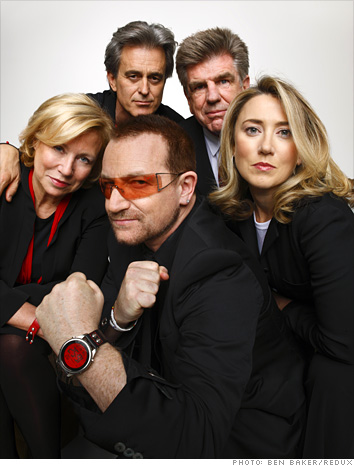
What do you get when you mix a rock star, a Kennedy family member, and Fortune 500 powerhouses like Starbucks (No. 261), Gap (No. 178), and Apple (No. 71)? An organization dedicated to fighting AIDS in Africa. (RED) licenses its logo on everything from lattes to laptops. In turn, the companies give part of the profits directly to the Global Fund to Fight AIDS, Tuberculosis, and Malaria.

Clockwise from left: Susan Smith Ellis, CEO, (RED); Bobby Shriver, co-founder, (RED); Tom Freston, principal, Firefly3; Juliet Flint, partner, Kleiner Perkins Caufield & Byers; Bono, U2 lead singer and co-founder, (RED)

source: money.cnn


chairman of the boards: ben baker
I was leafing through the new edition of Fortune magazine the other day, the annual Fortune 500 issue to be specific. Amongst all the facts, figures, graphs and charts I was excited to see a massive photo spread with the directors of some of America’s largest companies from my old mucker Ben Baker.

Holy shit this is a major feature (not that Ben isn’t a regular major feature playa). Not just in terms of subject but concept and logistics. Running the math quick this looks like a six figure + production for 12 yes 12 pages. Man the excess baggage bill alone looks like it is the equivalent of the GDP of a well to do First World Nation. !!!!! Great to see that people are still spending the big dollar on producing original content.

So having access to the man himself I thought why not delve in for a little behind the scenes. Mr Baker was willing and able and supplied us with lots of tasty titbits as you will see below.


Bono (L) Baker (R)


WTJ: So Ben how did this project come about ?

BB: This Project was green lit just before the collapse of the market last year, we thought it would never happen but Director of Photography Greg Pond and Managing Editor Andy Serwer decided to press on.

The shoots were split up between photo editors Nancy Jo Johnson and Armin Harris. The magazine made it very clear to possible Boards that the pictures had to be very ambitious, there were companies that wanted to be photographed but couldn’t commit to the scale so Fortune decided not to include them… Brave…

The scheduling was also very difficult as the boards only come together a few times a year and normally have their schedules set, so to make a big picture happen took a lot of work. Also the pressure and stress that a company has when we photograph one CEO is big… So imagine them giving us the whole board….

WTJ: So who came up with concepts ?

BB: This project spent a lot of time at Fortune before we got going, mostly Photography Director Greg Pond and Photo Editors Nancy Jo Johnson and Armin Harris….this project was also a big effort working with PR departments at the companies.. The magazine made it clear that they had to agree to a big idea out of the board room or not be part of it.. Fortune did say no to one very big company that couldn’t commit… That’s brave these days….

BB: This was a very long process.. To get them to agree was complicated, many, many layers of PR. It was postponed once as a board member had a broken leg the next chance was 3 months away. We spent 1/2 day pre lighting as we shot at 8am….was over in 30 – 45 mins…. Gwen Whitkin designed the table and walls… And did a great job…. It was just meant to be a moment of them having a lunch together, as simple as that.

WTJ: Did they eat the food and drink the drinks ?

BB: If you were getting free Maccas (that’s Australian for McDonalds) wouldn’t you eat all you can…. I didn’t mention that I photographed the super size me guy!..

I don’t think they did to be true.. But we had to shoot in a certain room because the special prep kitchen was right there… If you look close they really wanted the healthy menu up front….apples etc… If you agree to put their product in the shot most companies are happy, then you can work on getting the energy elsewhere..

BB: You can imagine the PR work to get a rock star’s schedule in line with the whole board, and not wanting it all about Bono, but that is the hook.. We did a shot with a red carpet and more… This was chosen as it fit the pace of the spread and works.


WTJ: This one looks like the least complicated of the shoots in term of concept. True or false ?

BB: True, sort of.. We did a red carpet shot.. Which took a long time to convince Bono..and works well, but the simple shot of them closer helped the pacing of the series and is more personal considering what RED is all about. We shot them before they went to dinner in NYC and made sure plenty of drinks were available.


Twitter - San Francisco

BB: Either the coolest new way of communicating or the most overhyped idea in a long time… We had the challenge of them being the youngest and coolest in the bunch.. But that exactly what they didn’t want to be perceived as.. We shot in a bar, walking shots, but this in the local park had the best feel…again, in balance with the whole project.

WTJ: Does Ben Baker Twitter ?

BB: Yeah right.. I don’t even know how to make a smiley face on cell phone….

Seriously… Its either the greatest feat of modern mankind or the most overhyped waste of time… I would prefer to call my mum and hear her voice….but that’s just me.


FED EX – DC

BB: I was just back from Australia and had to shoot this in 3 days… We wanted them in a cargo plane but that was impossible, we only had a few minutes in DC, so we managed to get a set builder to make these in 2 days… Jesse Kauffman rocked it… And then the challenge is for people to believe these are really 6ft tall… Reasons why we shot them side on and left the unfinished set to be seen.

WTJ: Any of the subjects have any hesitations climbing up on the letters ?

BB: Surprisingly not…. As long as you get the leader of the group (usually CEO) to be happy the rest usually get on board… So I got him on side right away, we had ladders and helpers… Doesn’t hurt that its the logo done very well.

And as much as the set is huge we try to keep it very low key as they arrive… And talk about something they are into.. (never business) The CEO is part owner of the Redskins, so we joked about football…..get the mind off the concerns of sitting on a giant F….


FEDERAL RESERVE BOARD. - DC

BB: This was the first in the series way back in November, so it was important to set the tone… We needed the grand nature of the room and the importance of the Board. I asked Fed Chief Bernanke if he had seen the Avedon show at the Corcoran… He just laughed.. I think he was in the middle of the Bear Sterns collapse that week…. I guess the gallery was not on the list!


COSTCO – Seattle

BB: As a New Yorker I had no idea what to expect… Wow.. We knew the picture had to big and everything in it had to be sold there ( except the cherry picker). Very cool that Bill Gates senior is there in the front… America loves big!

WTJ: Did u use extras to stand in when setting the shot ? How many variations did you do on this one ?

BB: We did get stand ins that worked at the store… And great help from the manager.. You have to remember that when its the CEO and board of directors, staff move pretty fast!


We did a variation on Costco that I like but didn’t make the cut.. Its them sitting around a table that is sold in the store, with shoppers going about their business…we always did a single page variation just in case the layout and page count had to change


ENVIRONMENTAL DEFENSE FUND - San Francisco

BB: Such a pleasant picture, a cool day at the beach.. 35 people in 30 minutes, on rocks, threatening rain, surf pounding, eagles flying, tide up, page break, smiles, color combos, then maybe a vertical try.. And then on to location number 2! Good thing I love my job…

WTJ: Were you shitting it the sun was going to come out ? Coulda fucked you ?

BB: Right on that one… Actually it was the most stressful shoot of the lot… It was forecast to rain for just that afternoon and not for 40 days before or after, but I never trust the reports..

And we had a very nervous PR team from EDF asking where the rain back up was? I didn’t really have one, so we built (at great expense) a shot in a nearby wooded area that was covered by tarps in case all hell broke loose.. Luckily it rained before, then after a little bit. The sun would have been over my shoulder, not the worst…I did have a row of bare heads in case of nasty shadows.. It would take 3 full trucks to light that area well…we had a budget, but that kind…

WTJ: You are always so smartly dressed on these shoots !!!!! Do you always wear a suit ?

BB: Yes, quite often…. I shoot lots of power types and if a suit gives my subject and me more respect, maybe 5 more minutes to shoot and the chance to get on the private chopper why not? Its amazing how may times my subjects see me in a suit, then tell me just how bad most photographers dress…. Its not a skateboard competition in Murdoch’s office, so why dress like it is? Its all about getting the picture right? Doesn’t have to just be for a wedding or funeral…

WTJ: So can you tell me how much was your excess baggage was with all this kit and your wardrobe ?

BB: Not that bad actually… Here’s the tip – join ASMP and buy American Airlines…. They are the only airline offering a media rate for photographers at $50 a bag…the rest are about $125…. Also print a letter from the mag, bring your ASMP card, plus the website rules from AA as most check in staff don’t know this yet….. You should be good…

WTJ: There were obviously a lot of people you needed to make happy. Were you happy with the final layout ?

BB: YES …..I think if every photographer edited and art directed the magazine it would always look very different.

We may work on our own but its a team sport……….There is so much to consider that goes on in magazine land that we are so unaware of…. There are a couple of images I would probably prefer in there.. But isn’t there always…….. I can’t ask much more from the fortune team…. Damn good, smart editors working their buts off in really bad days in publishing….its Walker Evans land.

All photographs and behind the scenes footage © Ben Baker

source: whatsthejackanory
Jim Sheridan's 'Brothers' Finally Coming Thanks To Relativity/Liongsate Deal; Drama Features U2 Songs Written For Film

4.27.2009


Jim Sheridan's "Brothers" was on our 60 Most Anticipated 2009 list, but the film seems to have almost vanished or at least been delayed and delayed.

A remake of the 2004 Danish film from director Susanna Bier ("Things We Lost In The Fire"), the film centers on a soldier declared deceased after being shot down in Afghanistan, who has actually survived but returns home only to suffer from battle fatigue and the realization that his wayward brother has moved in with the family. Both brothers, Tobey Maguire and Jake Gyllenhaal, are in love with the same woman played by Natalie Portman.

The film was reportedly set for a late Summer release this year and now it seems like this might actually happen. This morning it was reported by Variety that Relativity Media struck a multi-year output deal with Lionsgate covering up to five movies a year.

The first film under this new pact is of course, Sheridan's "Brothers." The next two films are "Season of the Witch" (Dominic Sena, eh) and the action/comedy "The Spy Next Door," neither of which really interest us much (or they don't sound great at the moment anyhow, we can always be convinced otherwise).


The song "White As Snow," from U2's latest album No Line on the Horizon, has been called their most intimate song and is a hymnal to a soldier dying in Afghanistan. It was written specifically for "Brothers" (Sheridan and Bono - Irish brethren - have a long history together, including Bono co-penning songs from "In America" and "In The Name of The Father"), but the band decided to release it on their new record after the film's many delays. The Guardian U.K. calls it, "unadorned, evocative and suggestive. And you don't even have to know what it's about to feel its quiet power or sense its sadness." Presumably it'll be featured in the film's credits.

Update: Apparently there's another song in "Brothers" written by U2 during the Horizon sessions that hasn't been released yet called, "Winter." The track can evidently be heard on the short film directed by Anton Corbijn that accompanies the album in the digipack format.

Without trying to be total cocks, Lionsgate does horror better than they do drama (at least lately), so let's hope this one gets a fair shake.

Posted by The Playlist at 2:54 PM

source: theplaylist.blogspot
Blues singer is King of the road

By Stephen Smith
BBC Newsnight Culture Correspondent

video: BB King talks about why he is still on tour at the age of 83

If it wasn't for the impeccable gallantry of its principal passenger and - it has to be said, his mature years - you could easily mistake BB King's tour bus for a passion-wagon.

The door jerks ajar with the report of an air brake, to reveal the titles of his greatest hits worked in electric-blue neon over each stair.

Inside, the thermostat is set at an inhibition-shedding toasty, the better to remind the bluesman of his origins in the cotton fields of the Mississippi delta.

Even the bunk beds of his long-time aides de camp, swagged as they are with creamy drapes, recall the imperishable sleeping-car scenes from Some Like It Hot.

When King - plain "B" to his friends - is finally encountered in his private lair at the rear of the bus, he's at the joystick of his personal entertainment system.

He's enjoying a Blues DVD on a flatscreen. Mahogany-effect panels conceal winking servers that power his state-of-the-art online options.

'Ruled by women'

"Flick that button there," he says, indicating a knob by an armrest. A moment later, I feel the couchette beneath me sliding silkily out from the wall of the bus, impelling me gently into the reclining position. Composing mournful blues which begin Woke Up This Morning, just isn't an option with this baby.

King is hardly an ingénue where the bedroom arts are concerned. He's been married twice, albeit the last union was dissolved so long ago that his resumed bachelorhood has already lasted for decades.


BB King will tour the UK later this year

He has reportedly fathered 15 children by various partners. And by his own account, he is a hopeless enthusiast of the fairer sex.

"They rule the world for guys like me. As I've got older, I've learned to respect them more," he says. "To me, they are more important than we are: how many babies have you had?"

"But you know, because I like women doesn't mean I want to sleep with them all!"

King, it may be worth stating, is 83 years old.

Far from being a diabolical den on wheels, it seems his tour bus is a thrifty alternative to hotel rooms for a musician who still clocks up north of 200 appearances a year.

It's a remarkable tally, especially for a man who doesn't enjoy the rudest of health (he is generously proportioned, and suffers from Type Two diabetes).

The guitarist's only concession to the years is to play his set sitting down, though he acts as though he'll stay on stage until the last fan has had his fill of King's trademark "trilling" licks and corny gags.

Self taught

Tonight he's nattily attired in a bespoke three-piece suit. It's stagecraft he learnt from his old mentor Frank Sinatra, who helped King to find bookings in Las Vegas when "coloured" acts endured segregation.

King is about to leave the tour bus and go on stage yet again, at a 1,500 seater venue in Philadelphia. Earlier this year, he collected his 15th Grammy award, for his album One Kind Favor.

BB King on US President Barack Obama

It is a long way from playing on the street corners where as a young man King could make more money in an afternoon than he would all week driving a tractor. He was self-taught, and his trademark style began as an attempt to mimic the flights of rhetoric achieved by his pastor in the pulpit on Sundays.

Even though King's illustrious resume includes opening for the Rolling Stones and collaborating with U2, the need to pay the bills, he says, is what keeps him on the road today.

"We used to play so many shows because the radio stations wouldn't play our records. If you can't get your songs to people one way, you have to find another."

King is the undisputed maestro of the blues, hailed by Rolling Stone magazine as one of the three greatest guitarists of all time. But he doesn't seem to recognise this himself, apologising for his "fat hands" and his failure to master chords.

Fear of fading

For all the miles he's clocked up on the road, he's never quite outrun the shadow of his humble origins.

The opening track of his latest album is morbidly entitled, See That My Grave Is Kept Clean. The song was written by Lemon Jefferson, a hero of King's, and the words proved to be grimly prophetic.

"When you don't have much money, you worry that they'll just put you in the ground someplace and your loved ones won't know where you are.

"After Lemon Jefferson died, I went to see where he was laid to rest. Do you know, I couldn't find the spot! This was a great master of the blues and he didn't even have a headstone."

As unlikely as it seems, the fear of an ignominious end in a pauper's grave haunts King, too.

Asked if he fears death, he says: "Well not as much as I used to, but I'm still working on that. You know what I'm saying, to make sure I have what I need at my death. To have a place where people know who I am."

Watch Stephen Smith's film on BB King in full on Newsnight on Thursday, 30 April, 2009 at 10.30pm on BBC Two.

BB King is on tour in the UK in June

source: bbc